Joinery Quoting Software — Price Jobs Accurately and Win More Work
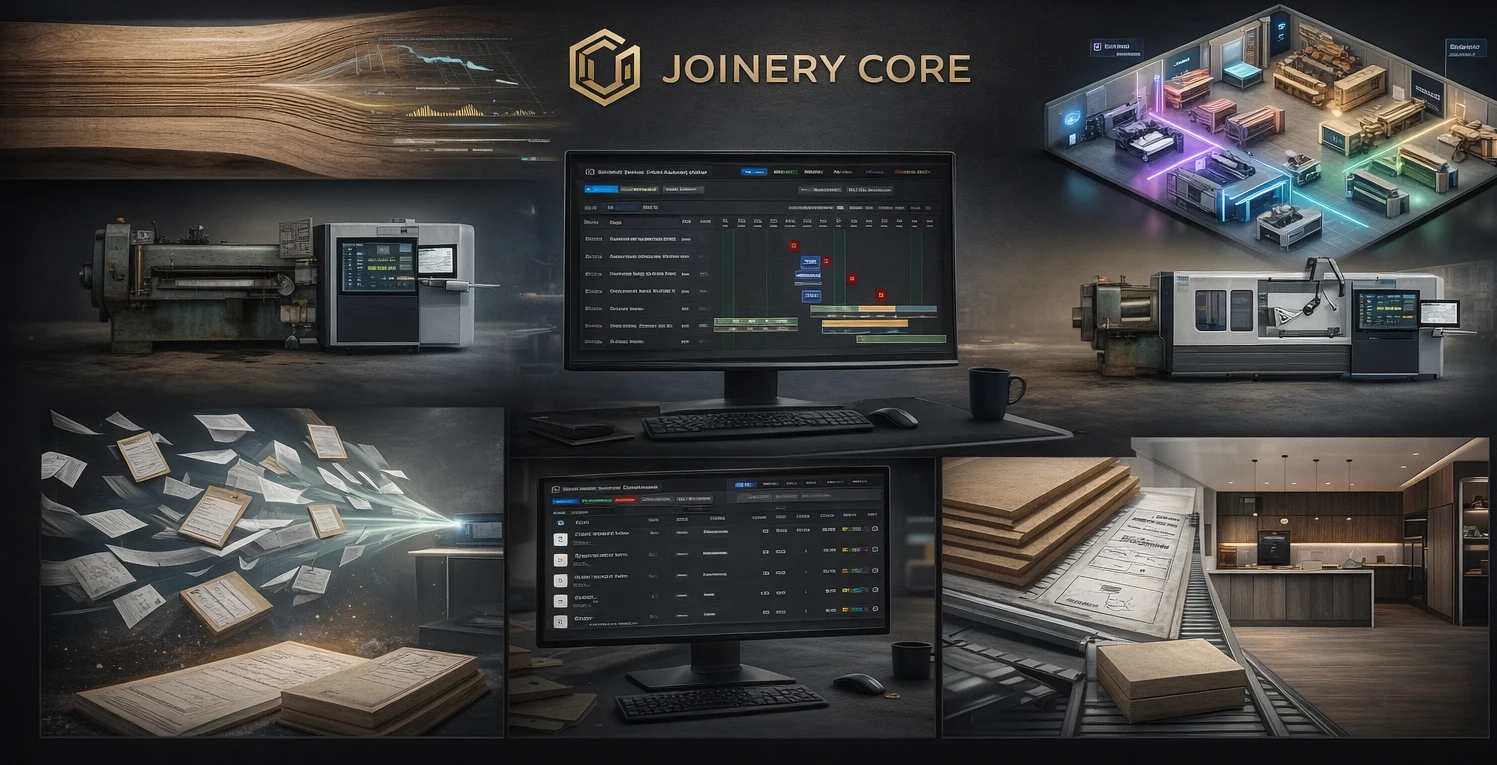
Every joinery workshop has a quoting problem. You spend hours measuring, calculating materials, estimating labour, and producing a professional document — then hear nothing back from half the clients. The other half accept, and three months later you discover the job made less money than you expected because your labour estimate was 30% too low.
Quoting is where joinery businesses make or lose their money. Not in the workshop — the workshop just executes the price you already committed to. If the quote is wrong, no amount of efficient production will fix it.
What Makes Quoting Joinery Work So Difficult?
Every Job Is Different
A kitchen is not a kitchen. One has six base units, solid oak doors, granite worktops, and a straightforward installation. Another has curved end panels, integrated appliances, bespoke mouldings, and installation in a listed building where you cannot drill into walls. Both are "kitchens" but the second takes three times longer to make and install. Quoting from templates or per-metre rates breaks down when every job has unique complexity.
Labour Estimation Is the Hardest Part
Material costs are relatively easy — you can get supplier quotes or use recent purchase prices. Labour estimation is where most joiners go wrong. Underestimating is human nature. You think about the production time but forget: setting out time, machine setup, hand finishing between coats, final adjustments, site visits, delivery, installation, snagging. These "invisible hours" can add 30-50% to the time you initially estimated.
No Feedback Loop
Without software, you have no systematic way to compare your quoted hours with actual hours. You finish a job, move to the next one, and the knowledge of how long it really took disappears. Six months later you quote a similar job and make the same estimation error.
What Joinery Quoting Software Does
Structured Quote Building
Good quoting software lets you build a quote from components: labour phases with hourly rates, material items with quantities and costs, subcontractor costs, and margins. Breaking a quote into visible components forces you to think about each element separately rather than pulling a total from thin air.
Quote Tracking and Pipeline
Every quote has a lifecycle: sent, viewed, followed up, accepted, rejected. Tracking this lifecycle tells you your conversion rate and average response time. If you send 20 quotes per month and win 4, your 20% conversion rate means you need to quote more to fill your workshop — or improve your quoting process to convert more.
Quote-to-Project Conversion
When a quote is accepted, it should become a project with one click. The quoted phases become production phases. The quoted materials become the material list. The quoted value becomes the project budget. This eliminates double entry and ensures production knows exactly what was sold.
Historical Data for Future Quotes
This is the most valuable feature of any quoting system. After completing 20 projects with tracked timesheets and material costs, you have a database of real information. You know that a standard door set takes your workshop 6 hours to make, not the 4 you used to estimate. You know that oak kitchens consistently use 15% more timber than the net calculation because of waste and defects. This data makes every future quote more accurate.
The cost of underquoting one job per month
- Average underquote: 15-20% of labour value
- On a job worth 8,000: that is 1,200-1,600 of unrecovered costs
- Over 12 months: 14,400-19,200 in lost margin
- That is more than most workshop software costs for 10+ years
- One accurate quote pays for the entire system
What to Look for in Quoting Software
Integration with Production
A standalone quoting tool is better than nothing, but a quoting module that feeds directly into production scheduling is better. When a quote converts to a project, the production team sees it immediately — phases, materials, and deadlines. No handoff meetings, no lost details, no "what did we actually sell?"
Material Cost Database
Maintaining current material costs is tedious but essential. Software that stores your material prices and lets you update them when suppliers change their rates means every quote uses current prices, not six-month-old figures from your last order.
Labour Rate Calculation
Your charge-out rate should reflect your actual workshop costs: overhead recovery plus direct labour plus margin. Software that lets you set this rate once and apply it consistently across all quotes prevents the inconsistency of different rates for different jobs.
Professional Output
A well-presented quote wins more work than a scribbled price on the back of a business card. Software that generates a clean PDF with your logo, itemised breakdown, payment terms, and validity period looks professional and builds client confidence.
Quote Management Best Practices
Follow Up Within 3 Days
Most quotes that go cold do so because nobody followed up. A simple call or email three days after sending — "did you receive the quote? Do you have any questions?" — can recover 10-15% of quotes that would otherwise be lost.
Track Why You Lose
When you lose a quote, record the reason: price, timing, went with competitor, project cancelled. Over time, patterns emerge. If you consistently lose on price for commercial work but win on residential, stop quoting commercial and focus where you win.
Review Estimates Quarterly
Compare your quoted hours and costs with actual outcomes. If assembly consistently takes 20% longer than estimated, adjust your estimating formula. This continuous improvement is only possible with data — and data requires software.
Estimate With AI
Joinery Core also includes an AI estimate assistant. Instead of typing a client's enquiry into your quote line by line, you attach their PDF — an enquiry, a furniture or cutting list, a room-by-room brief, or a drawing — and the assistant reads it, pulls out the rooms, items, dimensions and quantities, and builds a draft estimate for you to price.
You stay in control of every price: the assistant prices only from your Pricing guide or a figure you give, shows anything it works out in yellow as "suggested", and saves nothing on its own. It is an assistant, not a design tool — no CAD, 3D or CNC, and it never invents a price.
See how the AI estimate assistant works →
Frequently Asked Questions
Can I use my existing spreadsheet as a quoting tool?
You can, but you lose tracking (which quotes are outstanding?), pipeline visibility (what is my conversion rate?), and the connection to production (converting a won quote to a project). Spreadsheets handle calculation but not workflow.
Do I need separate quoting software?
Ideally not. The best approach is workshop management software with quoting built in, so quotes, projects, timesheets, and materials all live in one system. Separate quoting tools create data silos.
How do I price work I have not done before?
Break it down to components you have done. A bespoke bookcase might be new, but the individual elements — shelves, carcass, doors, finishing — are things you have made before. Price the components from your historical data, add a contingency for the unfamiliar assembly, and document the estimate so you can review accuracy afterwards.
Quote accurately using real workshop data
Joinery Core tracks quoted vs actual costs per project. Build your pricing database. 14-day free trial.