What Is Workshop Management Software? A Complete Guide for Joinery Owners
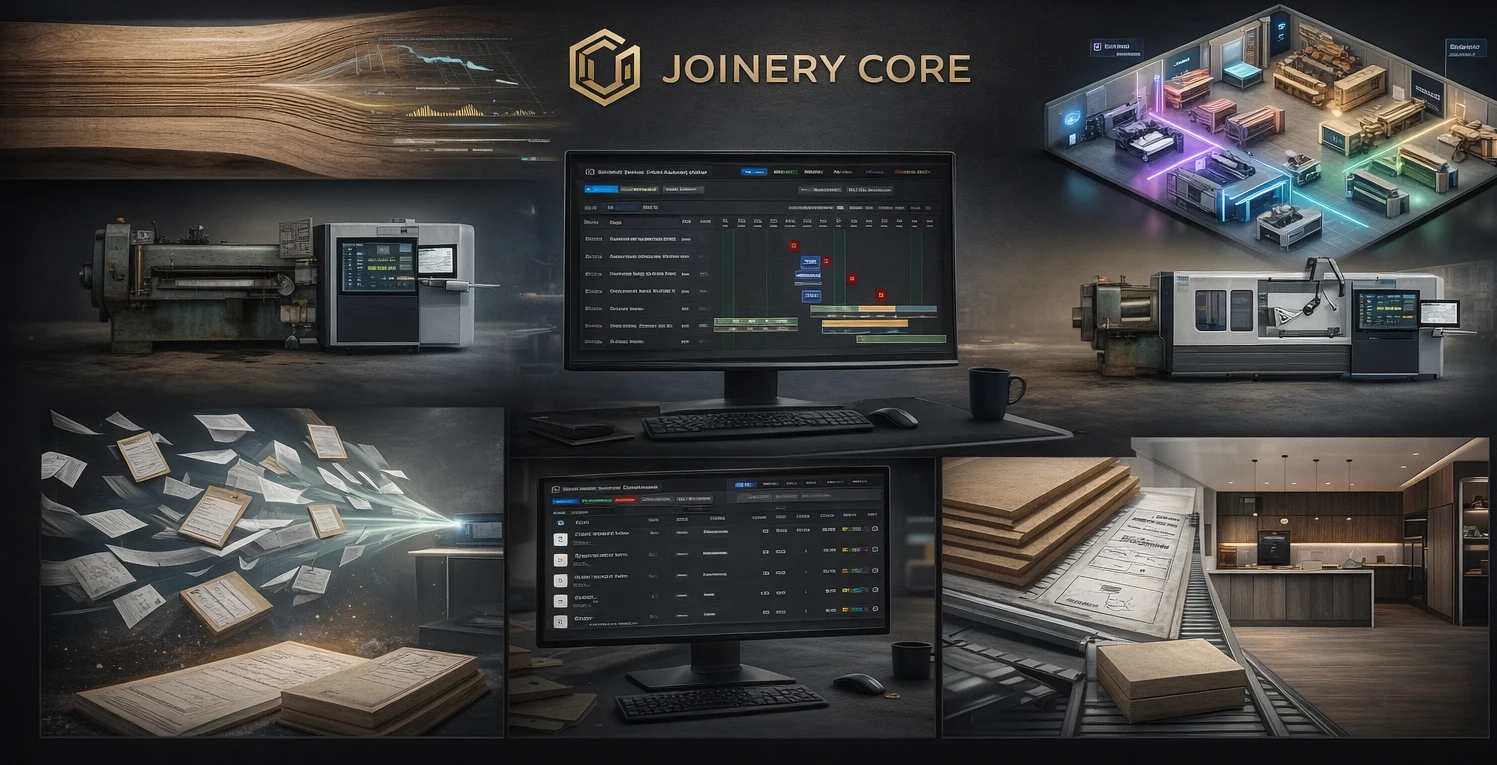
If you run a joinery workshop, you already manage it — you just might not have software doing it for you. Workshop management software replaces the spreadsheets, whiteboards, phone calls, and guesswork that most workshop owners rely on with a single system that tracks everything in one place.
But the term is broad. For a joinery workshop, it needs to understand your specific workflow: bespoke products, production phases, timber stock, team scheduling across overlapping projects, and financial tracking per job.
What Does Workshop Management Software Actually Do?
At its core, it gives you visibility. It answers the questions you ask yourself every morning: What is being worked on today? Which projects are behind? Do we have the materials? Who is doing what? Are we making money on this job?
1. Production Planning and Scheduling
This is the backbone. In a joinery workshop, you do not just have tasks — you have phases. A set of windows might go through timber cutting, machining, assembly, glazing, spraying, QC, and dispatch. Each phase takes a different amount of time, uses different workers, and depends on the previous phase being finished.
Workshop management software uses a Gantt chart or timeline view to lay these phases out visually. You can see at a glance which projects are in which phase, where bottlenecks are forming, and whether your sprayer is double-booked next Tuesday.
2. Stock and Material Control
Joinery workshops consume materials constantly — timber, glass, ironmongery, finishing products, consumables. Without tracking, you do not know what you have until you go looking for it. Good workshop software tracks stock levels in real time. Every time materials are booked out to a project, the system updates. When stock drops below a threshold you set, you get an alert.
3. Team Management and Timesheets
Your joiners, machinists, sprayers, fitters, and apprentices move between projects, sometimes within the same shift. Workshop software shows you who is working on what, today and next week. Timesheets capture hours per project so you know labour costs before the job is finished.
4. Financial Tracking Per Project
Most workshop owners know roughly whether the business is profitable. Fewer know which specific projects make money and which ones quietly eat their margins. Workshop software tracks quoted price, material costs, labour hours, deposits, and variations per project.
5. Client and Pipeline Management
Before a project hits your workshop floor, it goes through enquiry, quoting, approval, and scheduling. Workshop software tracks this pipeline so leads do not fall through cracks.
Five signs you have outgrown spreadsheets
- You have double-booked a worker or a machine more than once
- You have run out of materials mid-project without warning
- You cannot tell which projects made money until months later
- Your team asks you daily what they should be working on
- Leads go cold because nobody followed up on a quote
How Is Joinery Different from Other Trades?
Most workshop management software is built for field service trades — plumbers, electricians, HVAC. These businesses send individual workers to customer sites to complete single tasks. Joinery is fundamentally different. You manufacture bespoke products. Multiple projects run in parallel, each passing through a sequence of production phases. Workers are allocated to phases, not sites.
This means field service software (Tradify, Jobber, ServiceM8) is a bad fit. It can track jobs and invoices, but it cannot show you a production timeline, manage workshop phases, or track stock consumption per project.
What to Look For
| Feature | Generic PM Tool | Field Service Software | Workshop Software |
|---|---|---|---|
| Gantt production timeline | Basic | No | Yes |
| Phase-based scheduling | No | No | Yes |
| Stock control | No | Basic | Yes |
| Worker allocation per phase | No | No | Yes |
| Project-level financials | No | Basic | Yes |
| Understands joinery workflow | No | No | Yes |
When Is the Right Time to Switch?
Most workshop owners switch when they hit 3-5 concurrent projects with a team of 4+ people. The cost of not switching is invisible but real. A single underquoted project can cost more than a year of software.
The Bottom Line
Workshop management software is not about digitising your business for the sake of it. It is about replacing the systems that are already failing. For joinery workshops, the software needs to understand production phases, material tracking, and team scheduling across overlapping projects. Generic tools do not. Purpose-built workshop software does.
See workshop management software built for joiners
Joinery Core was built by a workshop owner. 14-day free trial, no credit card.